The last few weeks of the year have their own rhythm. Displays are coming down, reports are going up, and the children know the holidays are close. This is exactly when a simple, well-chosen sensory set-up earns its keep: it settles a busy room, gives you something to point to in your documentation, and, if you plan it right, doubles as your starting point for Term 1.
This guide gives you five tuff tray set-ups you can run in the final weeks of term. Each one comes with a recipe, a quick set-up, the EYLF V2.0 outcomes it connects to, and a clean-up tip. At the end there's a short planning section for wrapping up Term 4 and getting ready for Term 1 2027.
Everything here is open-ended. You set the table and the children decide where it goes.
First, the safety checklist
Read this once, then pin it near the tray. It applies to every recipe below.
- A note on measures. Cups are 250 ml metric cups and teaspoons are standard 5 ml teaspoons. Test each recipe once before you run it with a group, since textures vary with brands and the weather.
- Taste-safe is not edible. Taste-safe means a small amount in the mouth shouldn't hurt. It does not mean snack. Playgroup WA's taste-safe recipe sheet says exactly that: these activities "should not be consumed in large quantities", and children need supervision at all times.
- Heat-treat the flour. Raw flour can carry bacteria. For any recipe using flour, spread it on a baking tray, bake at about 175°C for around 5 minutes (or until it reaches 74°C), then let it cool completely before mixing. Australian Food Safety Week (7–14 November) is focused on the risks of raw and undercooked foods, so it's a good moment to build this habit into your routine.
- Check allergies and dietary needs first. Flour (wheat/gluten), cocoa and gelatine are common issues, and food colouring can bother some children. Check your enrolment records and your service's allergen policy before you bring any food-based material into a room.
- No water beads. The ACCC does not recommend expanding water beads for children under 3 and advises people to stop using them as toys or playthings. You won't find them in any of our set-ups, and we'd suggest keeping them off your trays altogether.
- Mind the small parts. Dry rice is a choking hazard for babies and toddlers. For under-3s, keep loose parts large and supervise closely.
- Use the stand as intended. Our stand holds the tray for supervised play. It isn't a table, seat or step, so don't let children lean, sit, climb or pull up on it. It's best for children who can already stand and walk on their own, with an adult supervising at all times.
- Wash hands afterwards. Hygiene is part of Outcome 3 in the framework (more on that below), so make it part of the routine rather than an afterthought.
The EYLF in one minute
The Early Years Learning Framework (V2.0, 2022) has five learning outcomes:
- Children have a strong sense of identity
- Children are connected with and contribute to their world
- Children have a strong sense of wellbeing
- Children are confident and involved learners
- Children are effective communicators
Sensory and messy play touches all five, but for the set-ups below we've focused on the three that most clearly show up in a tuff tray: Outcome 3 (wellbeing, including physical learning), Outcome 4 (confident and involved learners) and Outcome 5 (effective communicators). The links are suggestions to help your planning. You know your children and your documentation, so adjust them to fit.
Set-up 1: Rainbow rice sort
Best with: the Rainbow Swirl Insert ($59.95). Six bright colours spin out from the centre like a pinwheel, which makes sorting and matching almost automatic.

What you'll need (per colour)
- 1 cup (250 ml) uncooked white rice
- 3 teaspoons white vinegar
- 10–20 drops food colouring
- 1 zip-lock bag per colour
- A tray lined with baking paper, to dry
- Cups, spoons, small bowls and tongs
Make it
- Put the vinegar and colouring in the bag, add the rice and seal it.
- Shake until the rice is completely covered. If it looks patchy, add another teaspoon of vinegar and a few more drops of colour and shake again.
- Tip it onto the lined tray in a single layer and leave it to dry. Overnight works well.
- Store each colour in an airtight container.
Optional: Playgroup WA suggests baking the rice for 5 minutes at 180°C first if you're concerned about raw rice. And bin it if it gets wet during play.
Set it up: Put the Rainbow Swirl Insert in the tray and pile mixed rice in the middle with a few scoops and small bowls. Invite the children to send each colour "home" to its section.
EYLF links
- Outcome 5: Children begin to understand how symbols and pattern systems work. The framework suggests educators provide "a wide range of everyday materials that they can use to create patterns and to sort, categorise, order and compare."
- Outcome 4: Children develop a range of learning and thinking skills and processes such as problem solving, inquiry, experimentation… One of the listed examples is children who "create and use representation to organise, record and communicate mathematical ideas and concepts."
- Outcome 3: Children become strong in their physical learning and wellbeing. Scooping, pouring and picking up with tongs is children who "manipulate equipment and manage tools with increasing competence and skill."
What they're learning: sorting, matching, one-to-one correspondence and counting; hand-eye coordination; patience while they work out how to get the last stray grain out of the wrong colour.
Try this: Ask "I wonder how many scoops fill the blue section?" and let the children test it.
Clean-up tip: Put a sheet or old tablecloth under the stand before you start. When you're done, gather up the corners and pour everything back into the tub. Wipe the insert (it's made from a soft, wetsuit-style material that wipes clean) and check your rice for anything damp. Wet rice goes in the bin.
Safety: Rice is a choking hazard for babies and toddlers, so keep it for older children and supervise closely.
Set-up 2: Digger mud (cocoa oobleck)
Best with: the Busy City Insert ($59.95), with a few toy diggers and trucks. The roads, parks and shops turn into a very muddy construction site.

What you'll need
- 1½ cups (375 ml) cornflour
- ¼ cup (60 ml) cocoa powder
- 1 cup (250 ml) cold water
- A bowl and a wooden spoon
- Toy diggers, trucks, cups and scoops
Make it
- Mix the cornflour and cocoa in the bowl, then add the cold water.
- Stir. The recipe from Playgroup WA says it should be "hard to stir, but runny when poured".
- If it's too stiff, add a little more water. If it's too runny, add a little more cornflour.
If you'd like plain oobleck, our oobleck guide has the classic version.
Set it up: Pour the mud onto the Busy City Insert, or straight into the bare tray if you'd rather play it safe with stains. Cocoa can stain, so try a small corner of the insert first. Add diggers and let the construction crew get to work.
EYLF links
- Outcome 4: Children develop a range of learning and thinking skills and processes… The framework's examples include children who "use trial and error to explore different possibilities through 'cause and effect'" and "manipulate objects and experiment with 'cause and effect', trial and error, and motion."
- Outcome 5: Children express ideas and make meaning using a range of media. Look for children who "engage in play to imagine and create roles, scripts and ideas", such as foremen, drivers and a very serious road inspector.
- Outcome 3: Children become strong in their social, emotional and mental wellbeing. Shared construction play is a great place to see children "increasingly cooperate and work collaboratively with others."
What they're learning: cause and effect (why does it go hard when I squeeze and runny when I stop?), cooperation, and imaginative role play.
Clean-up tip: Scrape as much as you can into the bin. Don't wash large amounts of cornflour down the sink, because it can set in your pipes. Wipe the insert and tray with warm soapy water. Our tray-cleaning guide has more.
Allergy note: cocoa and cornflour are the only ingredients, but check with families before you serve cocoa-based play.
Set-up 3: Sea spaghetti
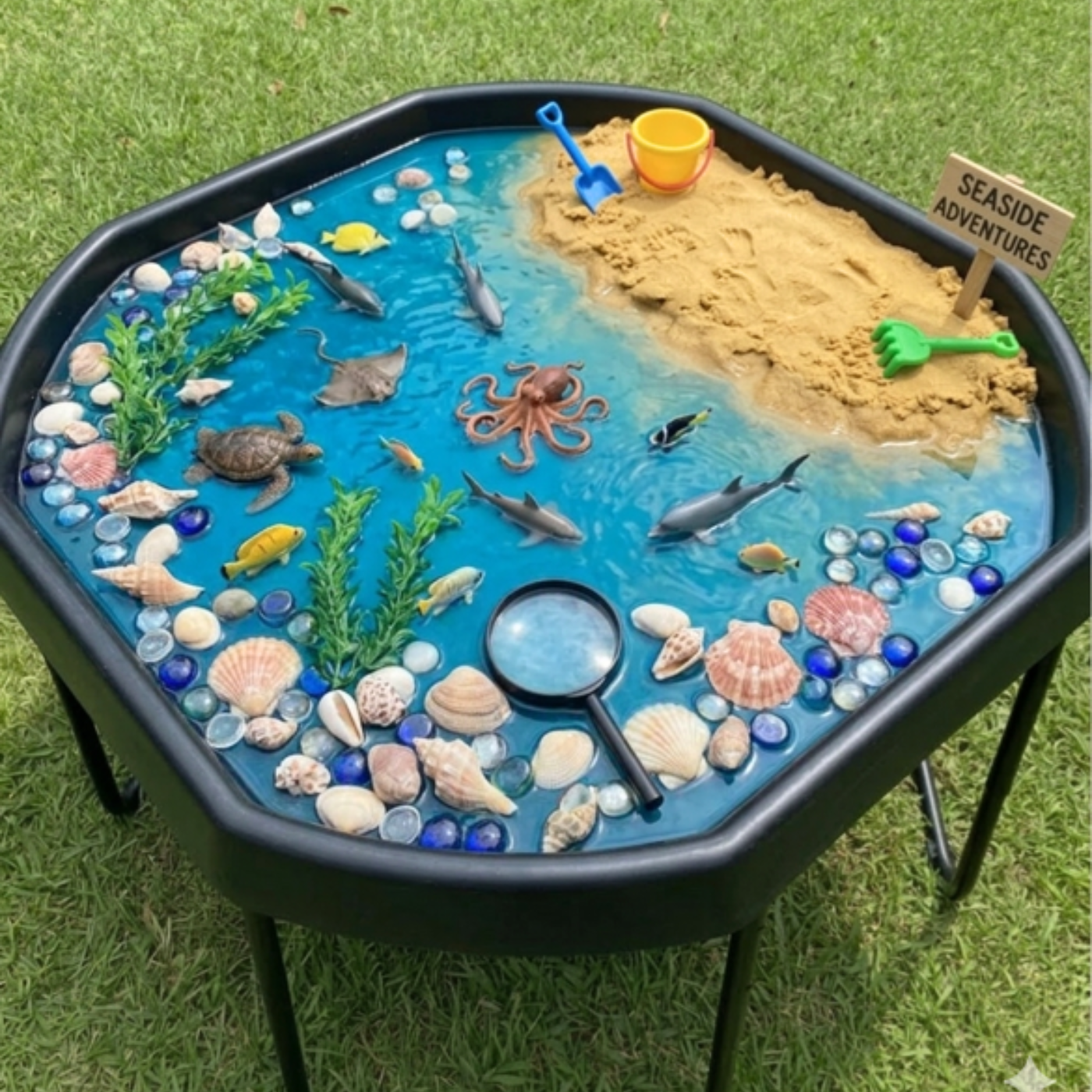
Best with: the Water World Insert ($59.95). It's made from waterproof PVC, so you can add real water straight onto it for genuine water play, and the rippling design turns the tray into an ocean.

What you'll need
- 1 packet of spaghetti (or gluten-free spaghetti)
- A few drops of olive oil
- Food colouring in six colours (about 20+ drops per colour)
- 6 zip-lock bags
- A large pan or tray
- Tongs, small scoops and plastic sea creatures
Make it (adapted from The TipToe Fairy)
- Cook the spaghetti according to the packet and drain it.
- Add a few drops of olive oil at a time, just enough to stop it sticking.
- Spread the spaghetti on a tray and let it cool completely.
- Divide it equally between six bags. Add about 20 drops of a different colour to each bag, close and shake gently. Add more colour to any patches that look pale.
- Tip the noodles into a large pan to dry off a little.
It will be slightly oily, so keep paper towels or smocks handy and wash hands afterwards.
Prefer something simpler? Playgroup WA's version uses mung bean vermicelli noodles. Boil them for 2 minutes, turn off the heat, add a few drops of colouring and let them sit for 1 minute, then drain and rinse in cold water until the excess colour washes out.
Set it up: Lay the Water World Insert in the tray, add a splash of water, then pile the spaghetti in and add sea creatures. Offer tongs and small scoops for "rescue missions".
EYLF links
- Outcome 3: Children become strong in their physical learning and wellbeing. Tongs and scoops give children practice at combining "gross and fine motor movement" and managing tools.
- Outcome 4: Children resource their own learning through connecting with people, place, technologies and natural and processed materials. The framework asks educators to "provide sensory and exploratory experiences with a wide variety of open-ended natural and processed materials", and noodles are a very good example.
- Outcome 5: Children express ideas and make meaning using a range of media. Children "use language, sounds, gestures and movement to engage in play to imagine and create roles, scripts and ideas."
What they're learning: fine motor control, sensory exploration (cool, slippery, wriggly), and storytelling about what lives in the sea.
Clean-up tip: Bin the spaghetti at the end of the session rather than keeping it, and put it in the bin, not the sink. Tip the water out, wipe the insert and let it dry flat.
Allergy note: regular spaghetti contains wheat. Use gluten-free pasta where needed, and check any colouring.
Set-up 4: Cloud dough letters
Best with: the White Board Insert ($94.95), made in Western Australia. It has a smooth, wipe-clean surface that suits drawing, writing and practising letters and numbers.

What you'll need
- 4 cups (1 litre) plain flour, heat-treated and cooled (see the safety checklist)
- ½ cup (125 ml) vegetable oil (not baby oil, so it stays taste-safe)
- A large bowl
- Small spoons, brushes and letter or number cards
Make it
- Mix the cooled flour and oil with your hands until it holds a shape when squeezed but crumbles easily.
- For a darker "dirt" version, the Raising Wild Things recipe uses 5½ cups flour, 1 cup oil and ½ cup cocoa powder.
Set it up: Spread a thin layer on the White Board Insert and show children how to draw with a finger. Add letter or number cards, brushes or small tools for making marks. If a child needs a fresh start, they can shake or smooth the surface and begin again.
EYLF links
- Outcome 5: Children express ideas and make meaning using a range of media. Look for children who "begin to use images and approximations of letters and words to convey meaning", and who "explore a range of materials and their properties."
- Outcome 5: Children begin to understand how symbols and pattern systems work. The framework also encourages educators to engage children in noticing, using and discussing symbol systems such as letters and numbers.
- Outcome 4: Children develop a range of learning and thinking skills and processes… Smoothing and re-drawing is trial and error in action.
What they're learning: pre-writing, letter formation, number recognition, and the confidence that comes from knowing you can always smooth it over and try again.
Clean-up tip: Scoop the dry dough into an airtight container. It will keep for a couple of weeks if sealed. Then wipe the insert with warm soapy water, because oil can leave a residue.
Allergy note: flour means wheat and gluten. Heat-treat the flour first and check your enrolments.
Set-up 5: Calm slime
Best with: the Small Tuff Tray (70 cm) ($65) for a quiet corner, a smaller group or a toddler room, or any tuff tray you already have.

What you'll need
- 3 level teaspoons psyllium husk powder
- 1 cup (250 ml) water
- Food colouring (natural colours if you can)
- A large microwave-safe bowl
- Small scoops, cups and a few toy animals or loose parts
Make it (adults only, adapted from 7 Days of Play)
- Mix the psyllium husk, water and colouring in the bowl.
- Microwave for 5 minutes. Keep an eye on it, because microwaves vary.
- Let it cool completely before handling.
The result is stretchy but a little grainy compared with commercial slime. The recipe is taste-safe for ages 12 months and over, but it isn't meant to be eaten, and large amounts of psyllium can upset tummies.
Set it up: A single material and very little else. Put the slime in the tray with a couple of scoops and a few small animals, then step back. If the room is lively, this is the one to set up in a quieter corner.
EYLF links
- Outcome 3: Children become strong in their social, emotional and mental wellbeing. Examples include children who "show an increasing capacity to understand, self-regulate and manage their emotions" and "enjoy moments of solitude."
- Environment: ACECQA's learning environments information sheet notes that educators "plan and provide both active and calming spaces, as well as various times across the day for active and quiet play."
What they're learning: calm, focused hand play, managing sensory input, and slowing down.
Clean-up tip: Scoop and bin. Wipe the tray with warm soapy water. Make a fresh batch next time rather than saving it.
Safety: The cooling step is important. Keep the hot-bowl part for adults only.
More set-ups we've already shared
If you'd like to add to your rotation, we've covered these in more detail:
- Aquafaba foam, a light, fluffy base made from chickpea liquid
- Frozen friend rescue and melting ice, good for hot days

- Homemade play mud
- Switching inserts through the week so one tray feels like many
Quick reference: recipes mapped to the EYLF
| Set-up | Insert | Main EYLF outcomes |
|---|---|---|
| Rainbow rice sort | Rainbow Swirl | 5 (symbols and patterns), 4 (problem solving), 3 (physical learning) |
| Digger mud | Busy City | 4 (cause and effect), 5 (play roles and ideas), 3 (social wellbeing) |
| Sea spaghetti | Water World | 3 (physical learning), 4 (natural and processed materials), 5 (play roles) |
| Cloud dough letters | White Board | 5 (letters, symbols), 4 (trial and error) |
| Calm slime | none (Small Tuff Tray) | 3 (self-regulation, calm), plus a calm space |
Wrapping up Term 4 and planning Term 1 2027
The dates. For WA public schools, Term 4 2026 ends on Thursday 17 December, and Term 1 2027 starts on Monday 1 February 2027 (see the WA Department of Education term dates). Independent schools, kindies and early learning centres may run to different dates, so check your own calendar.
In the final weeks
- Choose one or two set-ups from this guide and run them for a week or more, so you can observe and document children returning to the same materials.
- Make dry bases (rice) in advance. Make wet and cooked bases (oobleck, noodles, slime) on the day.
- Keep a list of which set-ups worked, which children were drawn to which materials, and which outcomes you saw.
Packing away for the break
- Dry rice, once fully dry, can go into an airtight container. One recipe source says it stores well for a long time.
- Cloud dough keeps for a couple of weeks if sealed, so we'd make a fresh batch in Term 1.
- Bin anything wet, cooked or made fresh.
- Wipe down trays and inserts and let them dry fully before you stack them.
Starting Term 1
- Begin with a calm set-up (Calm slime or Rainbow rice) while children settle back in.
- Plan a simple four-week rotation, for example: week 1 settle (calm slime), week 2 sort and pattern (rice), week 3 marks and letters (cloud dough), week 4 construction (digger mud).
- Rotate the insert, not the tray: one tray and a few inserts goes a long way.
- Update your allergen register and risk assessments before you introduce any food-based material. Supervision is part of the National Quality Standard (Quality Area 2, Element 2.2.1), and ACECQA's learning environments information sheet is a useful reflection tool.
Setting up your stations
You don't need to buy everything at once. Here's how the pieces fit together, with current prices.
For one station

- Tuff Tray & Stand Package: $245. A 100 cm tray (beige, white or black) and an adjustable metal stand with three heights (46, 56 and 66 cm).
- Or the Ultimate Tuff Tray Bundle: $375. A tray, the stand and three inserts: Busy City, Water World and Rainbow Swirl, which are the ones used in set-ups 1–3.
- White Board Insert: $94.95, for set-up 4.
- Tuff Tray Cover: $34.95 (or $15 when added to a bundle) to protect a set-up overnight.
For smaller spaces and toddler rooms
- Small Tuff Tray (70 cm): $65.
- Small Tuff Tray & Stand Package: $190.

For a whole service

- Education Bundle: $1,047.50 (total value $1,152.65, so you save $105.15). Three full-size tray-and-stand packages, all seven full-size inserts (White Board, Mirror, Grass, Paper, Busy City, Rainbow Swirl and Water World) and three Tuff Tray Covers. Great for services setting up multiple rooms or outdoor areas.
- Ultimate Classroom Set: $2,065.93 (total value $2,347.65, so you save $281.72). Three full-size and three small tray-and-stand stations, with 18 full-size inserts (each large tray gets Busy City, Rainbow Swirl, Water World, Grass, Mirror and Paper) and 9 small inserts (each small tray gets Grass, Mirror and Paper). Six stations, ready to go.
Grants and purchase orders. Both pages say you can ask us for a grant-ready quote aligned to EYLF outcomes. They also say that schools, councils and approved early learning services can use purchase orders on 30-day terms, on application, and that if you need a formal quote for a grant application, you can email us at emilie@busylittlefingers.com.au and we'll have it to you the same day.
A note on Mirror Inserts. Both bundles include Mirror Inserts, which are currently on pre-order. The product pages say new stock is due on 18 November, and that your bundle will be dispatched in full within a few business days of it landing. If you'd like the in-stock items sooner, contact us and we can arrange a split shipment.
One last thing
You don't need all five set-ups, and you don't need them to look like the pictures. Pick one, put out one material and a few tools, and watch what the children do with it. Write down what you see. That's your Term 1 plan started.
Want help choosing the right set-up for your service, or a quote for your centre? Get in touch at emilie@busylittlefingers.com.au and we'll help you work it out.