Messy play is one of the best things you can offer a child, until someone asks whether that flour dough is actually safe to taste, or a water-bead tray shows up on your kindy verandah. Australian Food Safety Week runs 7–14 November 2026 with a focus on the risks of raw and undercooked foods, and it is a good week to tighten a few messy-play habits at home and in early learning.
This is not another recipe roundup. It is a plain-English safety explainer: what to use, what to skip, and how to keep sensory play fun without the worry. (If you want taste-safe recipes, our Taste-Safe Pantry post already has those.)
Why this matters right now
Two things sit side by side this month. First, Food Safety Week reminds us that "from the pantry" does not automatically mean "safe to lick". Raw flour can carry bacteria that only heat will knock out, and that matters when babies and toddlers still explore with their mouths. Second, the Australian Competition and Consumer Commission (ACCC) has clear advice on expanding water beads, which still turn up in sensory play ideas online. Getting both right builds trust with families and keeps educators' documentation tidy.
What to skip: expanding water beads
We do not recommend expanding water beads for play — at home or in a service. The ACCC advises that expanding water beads are not recommended for children under three, and that you should stop using them as toys or playthings and keep them out of reach and out of sight. If swallowed, they can expand inside the body and cause intestinal obstruction; seek medical attention if a child swallows any. Read the full guide on the Product Safety Australia water beads page.
There are safer ways to get that "scoop and pour" feel: coloured water, ice, jelly kept chilled, or a wipe-clean water insert. More on those below.
Taste-safe is not the same as edible
"Taste-safe" means a small accidental taste is unlikely to make a child unwell. It does not mean the activity is a snack. Keep a clear "this is for playing, not eating" rule, even with yoghurt paint or cloud dough. For oral explorers, taste-safe bases still need close supervision, and you bin leftovers rather than saving them for lunch.
If your base uses plain flour (cloud dough, moon sand, edible dirt), heat-treat it first. Spread the flour on a baking tray and bake at about 175°C until the flour itself reaches 74°C — roughly five minutes, then cool completely before you mix. That step lines up with Food Safety Week's raw-food theme and is the same approach used in well-known taste-safe cloud dough methods (for example Raising Wild Things Sensory). Check wheat and gluten allergies before you start.
Safer bases: what to use instead
You do not need a cupboard of novelty fillers. These pantry and water options cover most of what children want from messy play:
- Water and ice play. Coloured water, ice cubes, pipettes and small-world animals. Cool for a WA spring day, and a natural swap for water beads. See our cool water and ice tuff tray ideas.
- Oobleck. Cornflour and water — classic, cheap and endlessly fascinating. Method here: how to make oobleck.
- Coloured rice or pasta. Dry sensory scooping and sorting. Still a choking hazard for babies and toddlers, so supervise and keep pieces bigger than a mouth for under-threes.
- Cloud dough with heat-treated flour. Flour plus vegetable oil (not baby oil) for a crumbly "sand" that holds a shape. Full notes in the Taste-Safe Pantry.
- Glue slime — older kids only. PVA glue slime is for bigger children with close adult supervision. It is not taste-safe. For younger ones, stick to chia or other taste-safe stretchy bases from our slime guides.
- Shaving foam. Fun texture for older preschoolers, but it is soap — not for tasting, and watch for eye and skin sensitivity. The foam-and-ice tray below is a sensory alternative to water beads, not a snack.
Contain the mess (tray + stand)
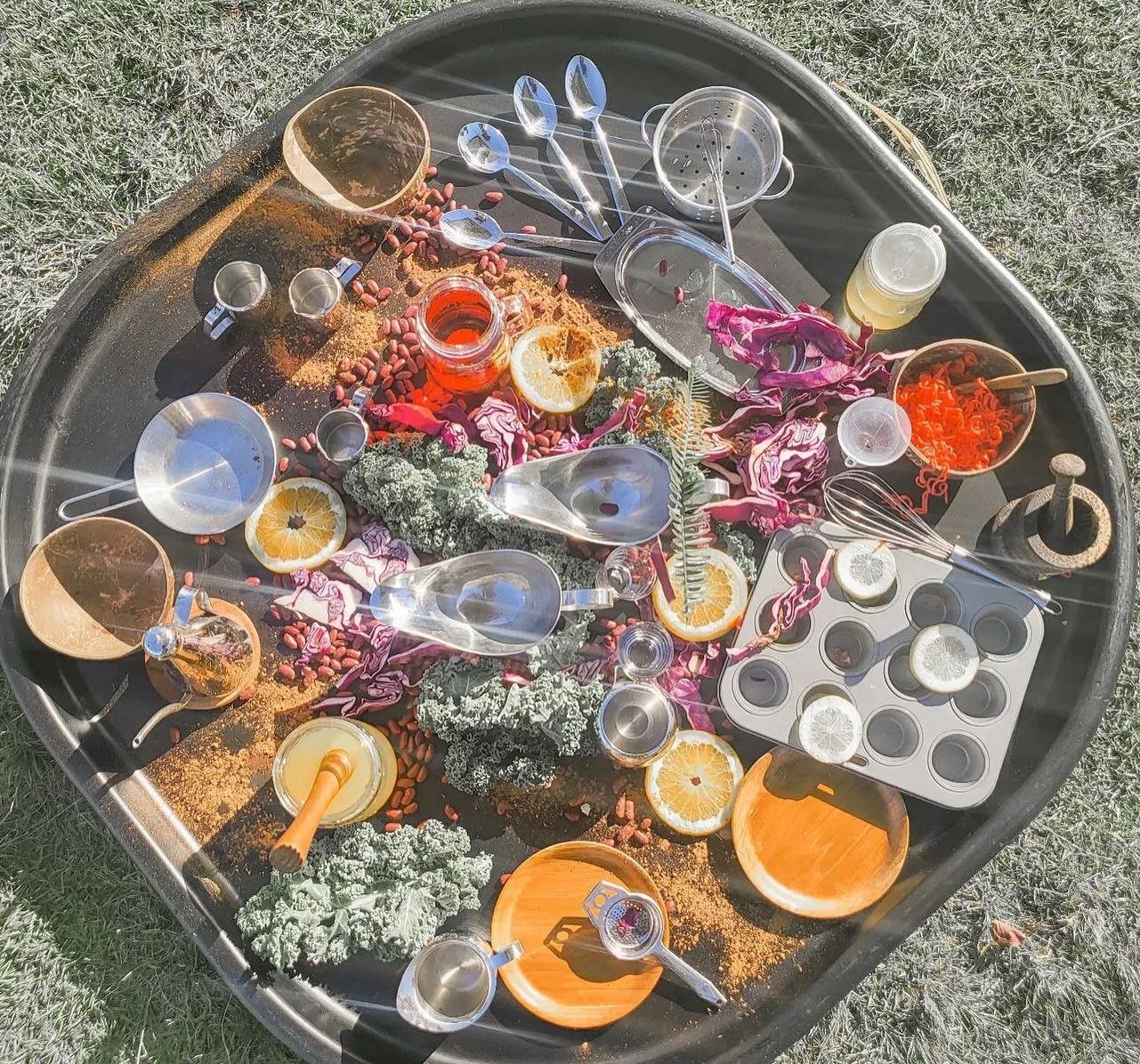
A deep-rimmed tuff tray does half the safety and sanity work for you. Spills stay in the tray, tools stay in reach, and you can set the whole invitation up outdoors in the shade. Pop the tray on a stand so children who can already stand and walk can reach comfortably. Our stands are for play at that height — they are not a table, seat or step, and they are best used with an adult supervising.
For real water play, a waterproof insert such as Water World means you can pour coloured water straight onto a pond scene and wipe it clean afterwards. A grass insert is lovely for digger and garden themes with dry bases.
What they're learning
- Safety habits: washing hands, "play not food", asking before tasting, and putting tools away.
- Science talk: what happens when flour is heated, why ice melts, why slime stretches, and why some things are for looking only.
- Self-regulation: staying with a tray, taking turns with pipettes, and stopping when hands need a wash.
For educators, those moments map neatly to EYLF Outcome 4 (confident and involved learners) and everyday hygiene routines under Staying Healthy guidance — without turning play into a lecture.
Clean-up tip
Build washing-up into the play. A bucket of soapy water and a sponge lets children finish the session by cleaning tools. Tip large amounts of cornflour mix into the bin, not down the sink (it can clog drains). Rinse the tray with the hose and stand it on its side in the sun to dry. Wash hands with soap and running water when you are done.
Safety and allergy notes
- Always supervise messy play. Even shallow water is a drowning risk for young children.
- Never use expanding water beads as toys or play materials. Follow ACCC advice and keep any existing beads out of reach and sight.
- Taste-safe ≠ edible. Heat-treat flour before cloud dough or flour-based dirt play; cool fully before children touch it.
- Check allergies and dietary needs: wheat/gluten, legumes (aquafaba), gelatine, food colouring, dairy and latex/soap sensitivities for foam.
- Glue slime: older children only, adult supervision, no tasting. Offer taste-safe stretchy alternatives for toddlers.
- Skip small loose parts for under-threes (beads, sequins, tiny animals that fit in a mouth).
- Stand safety: not a table, seat or step; best for children who can stand and walk, with an adult supervising.
- Outdoors in WA: seek shade, hats and sunscreen when the UV Index is 3 or above, and keep water play supervised.
- If a child swallows something they should not, call the Poisons Information Centre on 13 11 26, or seek emergency care if they may have swallowed water beads.
Getting set up
A simple safe station is a Tuff Tray ($80) on a Tuff Tray Stand ($175). For waterproof water play instead of beads, add the Water World Tuff Tray Insert ($59.95). For dry digger or garden themes, try Grass Tuff Tray Inserts ($32.95). Prefer to buy tray and stand together? Check current stock on the product pages — packages sell out from time to time, so we recommend the separate tray and stand when you want them ready to ship.
We ship Australia-wide to families, schools, kindies and childcare centres. Questions about a classroom set or a grant-ready quote? Email emilie@busylittlefingers.com.au. Share your safe set-ups with us on Instagram at @busy_littlefingers.