If your little one tests every new thing with their mouth first, you already know the messy play dilemma. You want them squishing, scooping and pouring, but you also know half of it is heading straight for their tongue. The good news is that your pantry already holds most of what you need for play bases that are taste-safe: made from food ingredients, so a curious lick or nibble isn't a worry.
One honest note before we start: taste-safe isn't the same as edible. These bases are for playing with, not for snacking on, and Playgroup WA's own taste-safe recipe sheet says they shouldn't be eaten in large quantities. Think "it's okay if a bit ends up in their mouth", not "morning tea".
Below are six bases we love for babies and toddlers, plus the things we'd leave off the tray altogether. Whether you're setting up on the back patio or planning the week in your toddler room, they all work beautifully in a tuff tray.
What you'll need
- A tray with a raised rim to keep it all contained. A Small Tuff Tray (70 cm, $65) is a lovely size for one or two toddlers.
- Cornflour, cocoa powder, plain flour, vegetable oil, rice, mung bean vermicelli noodles, psyllium husk powder and plain yoghurt (you won't need them all at once).
- Food colouring, zip-lock bags, a few mixing bowls and a baking tray.
- Chunky scoops, wooden spoons, cups, funnels and silicone moulds.
- An old towel and a bucket of warm soapy water for the end.
Six taste-safe bases, step by step
Cup measures are standard 250 ml cups. Where a recipe came from an overseas source using smaller US tablespoons, we've given the amount in millilitres. Recipes are always a little forgiving, so trust your hands as much as the measuring cup.
1. Cocoa oobleck (chocolate "mud")
This is the Playgroup WA version of our favourite goo, and it looks just like mud without a speck of garden dirt.
- Tip 1½ cups of cornflour and ¼ cup of cocoa powder into a big bowl.
- Stir in 1 cup (250 ml) of cold water with a wooden spoon. It will feel hard to stir but runny when you pour it.
- Too runny? Add a spoonful of cornflour. Too stiff? Add a splash of water.
- Pour it into the bare tray and offer spoons and cups first, then hands when they're ready.
Cocoa can stain, so this one is best straight on the tray rather than on a fabric or paper insert. If oobleck is new to you, our classic cornflour oobleck guide explains why it behaves so strangely.

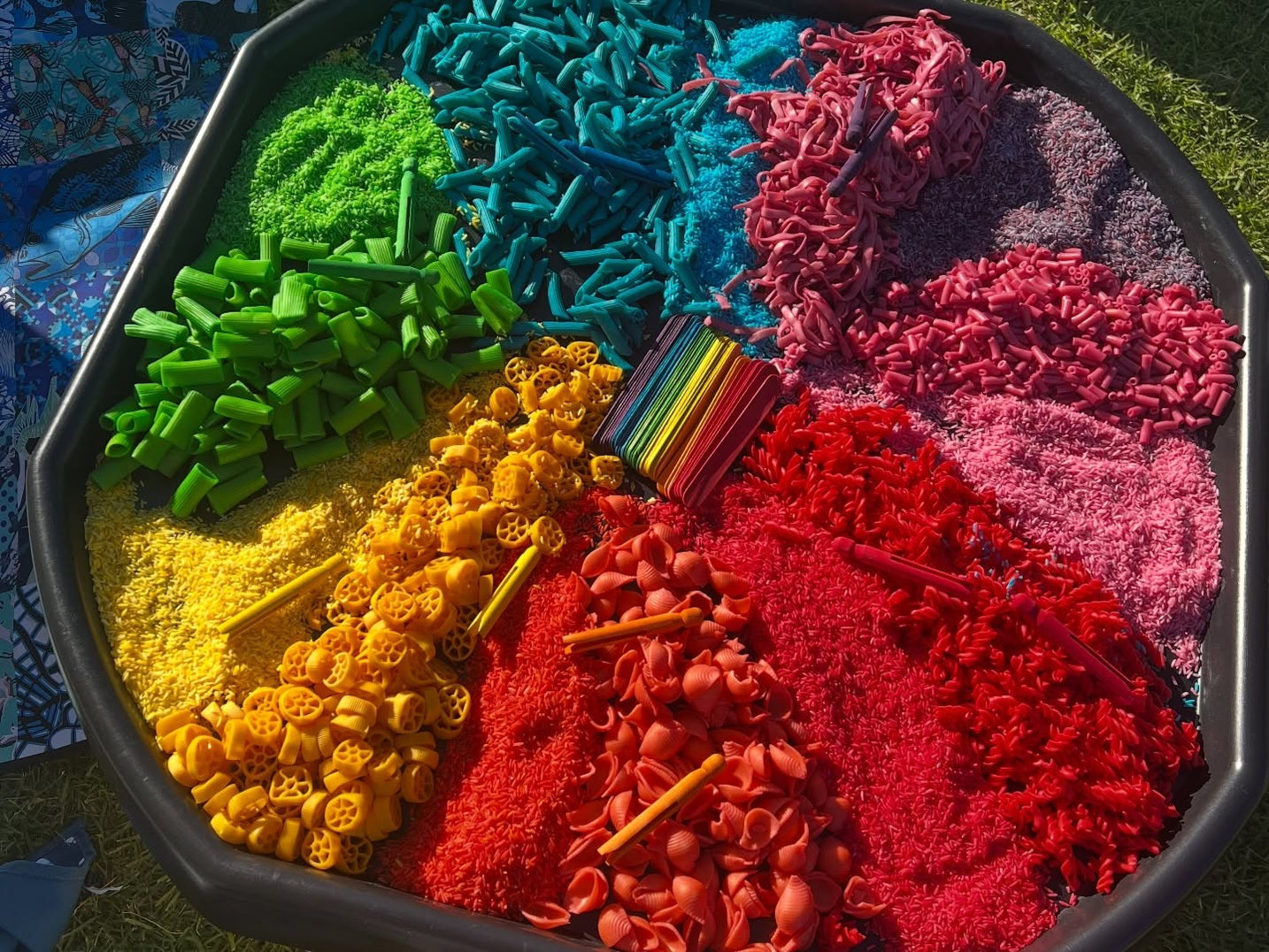
2. Rainbow rice
- Put 2 cups of uncooked white rice in a zip-lock bag. If you'd like, bake the rice on a tray at 180 °C for 5 minutes first and let it cool (Playgroup WA suggests this if you're worried about raw rice).
- Add a few drops of food colouring. Taming Little Monsters also adds about 15 ml of white vinegar per cup of rice to help the colour spread.
- Seal, shake until every grain is coated, then spread it on a tray or baking paper to dry, ideally overnight.
- Repeat with other colours and store it airtight once it's completely dry.
Dry rice is a choking risk, so save it for toddlers who are past the everything-in-the-mouth stage and stay right beside them. If it gets wet during play, throw that batch out. For colour sorting, it looks amazing on the Rainbow Swirl insert ($59.95), which fits our full-size Tuff Tray ($80).

3. Coloured noodles
Soft, slippery and easy for little fingers to grab, these are a great swap for rice with younger toddlers.
- Boil mung bean vermicelli noodles for 2 minutes.
- Turn off the heat, add a few drops of food colouring and let them sit for 1 minute.
- Drain, then rinse in cold water until the extra colour runs off.
- Let them cool completely before they go on the tray, and use them the same day.
Kitchen tongs, a colander and a few plastic cups turn this into a "noodle shop" in seconds.
4. Taste-safe cloud dough
Cloud dough is soft and powdery, then holds its shape when you squeeze it. It makes wonderful pretend sand or snow.
- Heat-treat the flour first. Spread 4 cups of plain flour on a lined baking tray and bake at about 175 °C for around 5 minutes, until a food thermometer reads 74 °C (the method Raising Wild Things uses). Let it cool completely.
- Add ½ cup of vegetable oil (an 8:1 ratio of flour to oil).
- Mix with your hands until it holds a shape when squeezed but crumbles easily.
- Add moulds, scoops and cookie cutters.
Use vegetable oil, never baby oil, if your child might taste it. Why the flour step? Raw flour isn't treated to kill bacteria such as E. coli and Salmonella, and the US CDC advises against children playing with dough made from raw flour. The UK Food Standards Agency notes that heat-treating at home reduces the risk but can't guarantee it's gone, so keep this one a play material rather than a snack and wash hands well afterwards. It's a timely reminder, too: Australian Food Safety Week runs from 7 to 14 November 2026 with the theme "Raw Food – know the risk".
5. Psyllium husk slime
No glue, no borax, just a stretchy, wobbly slime. 7 Days of Play suggests it from 12 months.
- Mix 1 US tablespoon (about 15 ml) of psyllium husk powder, 1 cup (250 ml) of water and a little food colouring in a large microwave-safe bowl.
- Microwave for about 5 minutes, watching closely because it can bubble over. This is an adults-only step.
- Let it cool fully before little hands go anywhere near it.
It's a little grainier and less stretchy than glue slime, and big amounts can upset tummies, so it's for squishing, not eating. Tip it onto a Water World insert ($59.95) and add a few chunky sea animals for a pond or ocean scene. Water World is waterproof and wipes clean.

6. Yoghurt paint
The easiest of the lot: stir a few drops of food colouring into small pots of plain yoghurt and let them finger-paint. Play Matters Australia lists yoghurt paint as a great option for little oral explorers. Lay a Small Paper Tuff Tray Insert ($19.95 for a pack) in the tray for a keepsake painting, or paint straight onto the tray and wipe it away afterwards.

What to leave off the taste-safe tray
- Water beads. The ACCC advises families to stop using expanding water beads as toys and to keep them out of reach of children. We don't recommend them in any set-up.
- Raw, untreated flour in no-cook doughs (see the cloud dough note above).
- Baby oil in cloud dough. Swap in vegetable oil.
- Dishwashing liquid and bubble bath foams. They're fun for older kids, but soap isn't taste-safe.
- Small loose parts such as beads, sequins, small figurines and gummy lollies for children under three.
What they're learning
Scooping cloud dough, pinching noodles and pouring oobleck build the hand strength and coordination that later help with holding a pencil. Comparing "runny", "crumbly" and "stretchy" grows early vocabulary, and watching oobleck switch between solid and liquid is real early science. For educators, these bases sit neatly within EYLF Outcome 4, which talks about offering sensory and exploratory experiences with a wide variety of open-ended natural and processed materials.
A few tips for educators
- Check your enrolment allergy records first. Watch for wheat and gluten (cloud dough), dairy (yoghurt paint), legumes (mung bean noodles) and any food colouring sensitivities.
- Some services and families prefer not to use food in play, so check your service's policy and talk with families.
- Offer scoops, tongs and gloves alongside hands-in play, so children who avoid certain textures still have a way in.
- Planning taste-safe stations for a whole room? Email Emilie for a quote on multiple trays and stands.
Clean-up tip
Lift the tray onto the grass or a towel before you start, so spills land somewhere easy. Scrape leftovers into the bin rather than the sink, because cornflour and cloud dough can clog drains. Then a bucket of warm soapy water and a cloth will have the tray clean in a couple of minutes. Our tuff tray cleaning guide has more ideas.
Safety and allergy notes
- Always supervise. Taste-safe means a small taste is okay, not that it's food.
- Check every ingredient against your child's allergies, especially wheat, dairy, legumes and cocoa.
- Cool anything cooked or microwaved completely before play.
- Wash hands with soap and water before and after messy play.
- For babies and new walkers, pop the tray on the floor. Our stands are best for children who can already stand and walk confidently, with an adult nearby.
Ready to set up?
For toddlers, the Small Tuff Tray & Stand Package ($190) brings play up to a comfortable height once they're steady on their feet, and the tray lifts off to use on the floor. If you've got older siblings or a group joining in, the full-size Tuff Tray ($80) gives everyone room to dig in.
One tray, a few pantry staples, and a very happy (and very messy) toddler.
Sources
- Playgroup WA, Taste Safe Messy Play recipe sheet
- Taming Little Monsters, rainbow rice
- There's Just One Mommy, taste-safe cloud dough
- Raising Wild Things, heat-treating flour for sensory play
- CDC, raw flour and dough
- UK Food Standards Agency, handling flour safely
- Food Safety Information Council, Australian Food Safety Week 2026
- 7 Days of Play, taste-safe slime for toddlers
- Play Matters Australia, messy play every way
- ACCC Product Safety Australia, water beads