By mid-morning in a Perth summer, the sandpit is too hot to touch and everyone is a little wilted. That's exactly when a tray of cool water and melting ice comes into its own: little hands go straight in, voices drop, and the hottest part of the day suddenly has a focus.
This Thursday, 5 November 2026, is Outdoor Classroom Day, a global day of action for taking children outside to play and learn. Whether you're planning for a kindy, a long day care yard or your back patio, here are four cool, shady tuff tray set-ups for Outdoor Classroom Day and the long WA summer ahead.
First things first: your sun-smart, water-safe set-up
- Check the UV, not the thermometer. Cancer Council WA recommends sun protection whenever the UV Index is 3 or above, which in Western Australia is most of the year. The SunSmart Global UV app or Bureau of Meteorology shows the day's sun protection times.
- Set up in the shade. Put the tray under a shade sail, verandah or big tree, and plan water play for the early morning or late afternoon when you can. On scorching days, bring the tray inside.
- Hats, clothing and sunscreen. Broad-brimmed, bucket or legionnaire hats (caps don't protect ears and necks), sun-protective tops, and SPF50 or 50+ broad-spectrum, water-resistant sunscreen applied 20 minutes before heading out and reapplied every two hours, or sooner once it's been washed off by all that splashing.
- Keep watch, always. Royal Life Saving Society Australia says a toddler can drown in just 3 cm of water. For under-fives, stay within arm's reach whenever there's water in the tray, and don't leave older children in charge of younger ones.
- Tip it out straight away. When play ends, empty the tray, buckets and jugs so nothing can collect water.
- Drink bottles nearby. Hot, busy children forget to drink, so keep water bottles within reach of the tray.
What you'll need
- A tuff tray on a stand at waist height, so children can stand around it and adults can see everything. Our Tuff Tray & Stand Package ($245) fits a small group; the Small Tuff Tray & Stand Package ($190) suits one or two children or a smaller patio.
- A few large ice blocks, frozen the night before in takeaway containers, loaf tins or milk cartons.
- Small plastic animals (polar animals, sea creatures, frogs) chunky enough for your age group.
- Water, blue or green food colouring, and a little table salt.
- Tools: pipettes or droppers, a spray bottle, tongs, a small sieve, scoops, cups and a jug.
- Natural bits from the garden: leaves, petals, herbs and citrus slices.
- Towels and a bucket for tipping water onto the garden afterwards.
Set-up 1: Arctic ice rescue

Nothing says "cool" like a polar rescue mission. The ice starts melting the moment it hits the tray, so children get to race the sun.
- The night before, half-fill a few containers with water, drop in one or two animals each, and freeze. Big blocks last longer than cubes and are safer for little ones who still mouth things.
- Pop out the blocks and arrange them in the tray with a shallow pool of blue-tinted water on one side.
- Set out the rescue kit: a spray bottle of warm (not hot) tap water, pipettes, a small bowl of salt with a spoon, tongs and a sieve.
- Invite children to free the animals. Which works faster: warm water, salt or warm hands? Let them test their theories.
- Use the tongs and sieve to move rescued animals to "safety", then count or sort them.
Older kindy and pre-primary children can add a sand timer and a tally chart to record which method won.
A note on salt: keep it to a small bowl with a spoon, and remind children to keep salty hands away from their eyes and mouths. Leave the salt out entirely if you have children who still mouth everything.
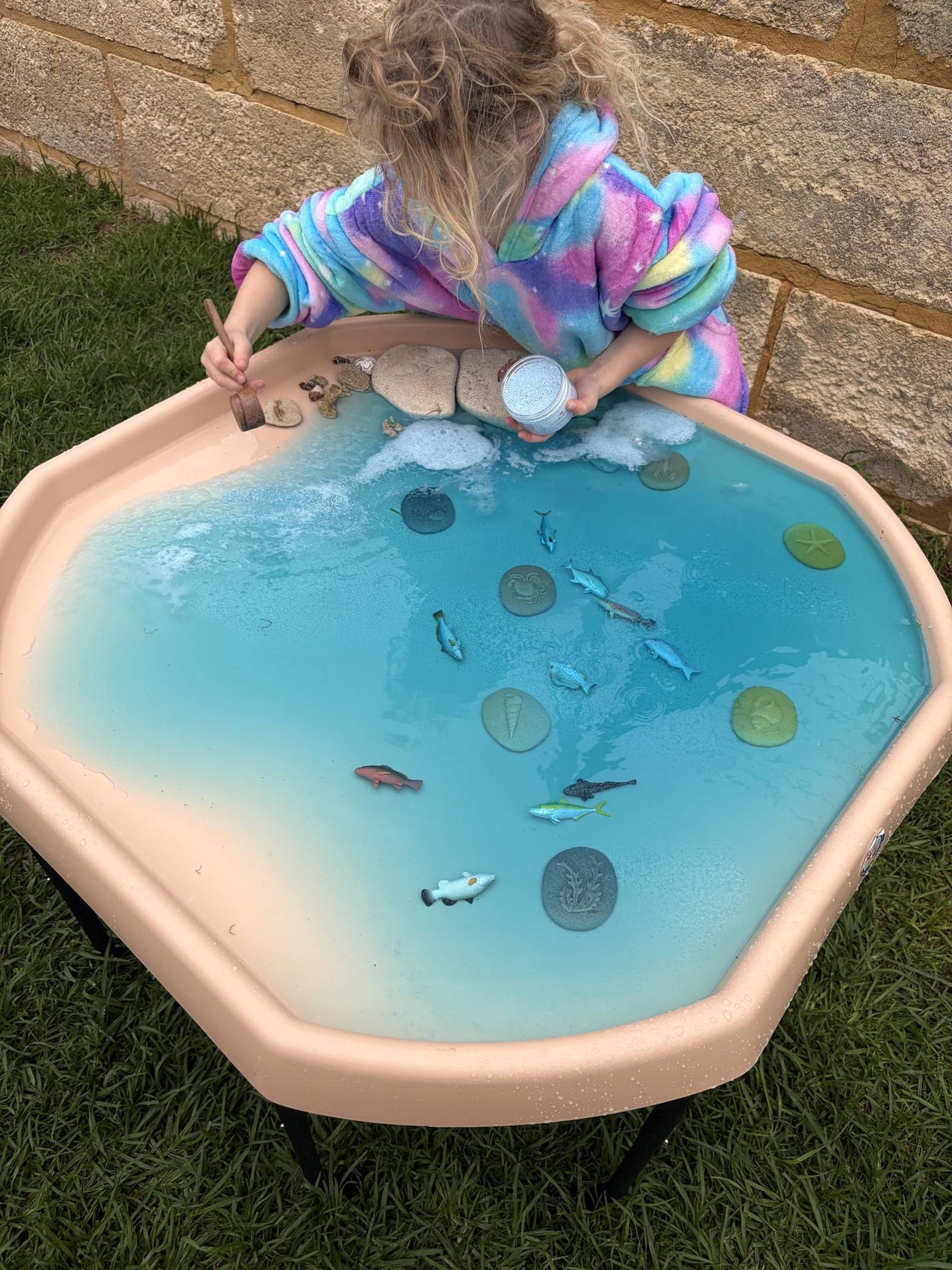
Set-up 2: Shady ocean small world

This is the set-up children return to again and again. Keep the water shallow: a few centimetres is plenty for floating, scooping and splashing.
- Tint a jug of water with a drop or two of blue food colouring and pour a shallow layer into the tray.
- Pile a few flat rocks or shells at one edge to make a "beach" so animals can climb out.
- Add sea creatures, a few ice cubes for "icebergs" (larger ones for younger children), and scoops, cups and a small net or sieve.
- Let children lead the story, whether it's a shark rescue or a family of turtles heading home.
Want a sea without the dye? Our Water World Tuff Tray Insert ($59.95) has a rippling water print and is made from waterproof PVC, so you can pour real water straight onto it, or use it dry for small world sea play on days when water isn't an option. It's custom-sized for our trays, so check it matches yours (it's designed for Busy Little Fingers trays bought from November 2025 onwards).

Set-up 3: Frog pond and pipettes

Pipettes are a quiet achiever. Squeezing, releasing and aiming takes real concentration and builds the small hand muscles children later use to hold a pencil. A frog pond gives all that squeezing a purpose.
- Pour a shallow puddle of blue water into the centre of the tray, leaving the edges dry.
- Add frogs, a few "lily pads" (green lids or felt circles work well), and some logs or tubes for hiding spots.
- Put a bowl of green water to one side with pipettes, and scatter foam letters around the dry edges.
- Challenge children to fill the lily pads drop by drop, give each frog a "rain shower", or spell a word with the letters, such as "frog", "pond" or their own name.
Educator tip: 6 to 15 November 2026 is FrogID Week, run by the Australian Museum, which makes this a lovely bridge into listening for real frogs in your local area.
Set-up 4: Garden potion kitchen

On a warm morning, take the tray to a patch of dappled shade and let children cook up a storm. Potion making is pure process play: no right answer, just stirring, smelling and serious conversation.
- Gather leaves, petals, herbs and orange slices; children love helping to collect them.
- Set out bowls, spoons, jars of coloured water and a mortar and pestle if you have one.
- Invite children to mix "cool-down potions" and describe them. What does it smell like? What colour did it turn? What does it do?
- When it's finished, the leftovers can go into the compost or garden bed.
Safety note: check that every plant you add is non-toxic, and don't put in anything a child is allergic to. Dried peas, lentils and seeds look gorgeous but are a choking hazard, so leave them out for children under three and supervise closely for everyone else.
What they're learning
These set-ups look like simple fun, and they are. They also map neatly to the Early Years Learning Framework (V2.0):
- Outcome 4, confident and involved learners: predicting, testing and explaining why the ice melts faster with salt or warm water.
- Outcome 2, connected with and contribute to their world: caring for rescued animals, noticing local frogs and plants, and tipping used water onto the garden.
- Outcome 3, a strong sense of wellbeing: calm, regulating water play, plus learning their own sun-smart routines.
- Outcome 5, effective communicators: new words like melt, freeze, float, sink and dissolve, and early letter play at the frog pond.
Clean-up tip
Scoop out the toys and ice, then tip the water onto a garden bed or lawn (skip any salty water, which plants don't love; pour that down the drain instead). Wipe the tray with a damp cloth and let it dry in the shade before stacking. If you've built a dry small world scene you'd like to keep for tomorrow, our Tuff Tray Cover ($34.95, or $15 as a bundle add-on) fits the full-size 100 cm tray and keeps out leaves and curious pets. Never cover and leave water in the tray; always empty it first.
Ready for a cooler summer of play?
If you're kitting out a yard or classroom for summer, the Tuff Tray & Stand Package ($245) gives you a waist-height play space that's easy to move into the shade as the sun shifts. Just want a tray? The Tuff Tray ($80) and Small Tuff Tray 70 cm ($65) work on the ground in a shady spot too.
Ordering for a service or school, or need a quote for a few trays? Email me at emilie@busylittlefingers.com.au and I'll help you put together the right set-up.
Stay cool, stay sun-smart, and happy Outdoor Classroom Day!
Emilie x