World Kindness Day falls on Friday 13 November 2026 — and you don't need a big assembly or a stack of worksheets to mark it. You need a tray, a few cups, and an invitation that helps little people practise being kind with their hands as well as their words.
This kindness tea-party set-up works at home on a quiet afternoon and just as well on a kindy verandah. It's warm, contained and full of turn-taking — with soft product links at the end if you'd like a tray and stand ready before Friday. (And if you're celebrating Directors' Day on Monday 10 November, the same thank-you note tray doubles beautifully for messages to your service director.)
Why a kindness tray this week?
World Kindness Day is observed every 13 November, marking the opening of the first World Kindness Movement conference in Tokyo in 1998. In Australia this year, schools and communities are being invited to record everyday acts of kindness — from handwritten notes to Free Dress Day fundraisers — as part of a wider push to make kindness visible and countable.
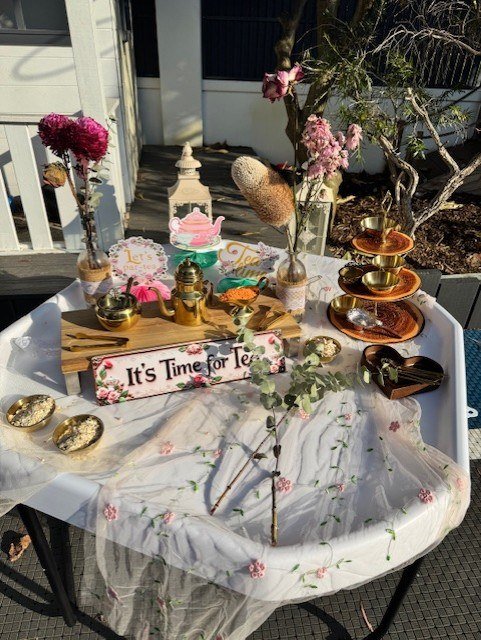
For early learners, kindness lands best when they can do it: pour a cup for a friend, write a name, share the eucalyptus "tea", take turns with the teapot. A deep-rimmed tuff tray keeps the whole invitation in one place so the mess stays small and the kindness stays big.
What you'll need
- A tuff tray (full-size or 70cm), ideally on a stand so children can stand and move around it
- A child-safe teapot, cups, spoons and a few small bowls (metal, wood or plastic — whatever you already own)
- A dry sensory base: oats, lentils, coloured rice or sand (skip anything that looks like expanding water beads)
- Optional nature extras: eucalyptus sprigs, dried flowers, orange slices, kale leaves
- Paper scraps, sticky notes or a wipe-clean surface for kindness notes and names
- Washable markers, chalk or letter tiles/magnetic letters
- A simple prompt card: "Pour a cup for a friend" or "Who will you thank today?"
- A towel and a bucket of soapy water for clean-up
Keep glass out of reach of under-threes, and choose cups and spoons that can survive a drop. When in doubt, leave the fancy china in the cupboard.

How to set it up (Kindness Tea Party invitation)
- Lay a soft base. Tip a thin layer of oats, lentils or coloured rice into the tray so cups "sit" and don't slide. Leave empty pockets for a teapot, note-writing zone and a nature corner.
- Set the tea station. Place the teapot, cups, spoons and a couple of bowls of dry "tea" (oats, petals, orange lentils). Add a short fabric runner or napkin if you like — pretty is optional; pourable is essential.
- Add a kindness-notes zone. Paper scraps, sticky notes or a whiteboard insert on one side of the tray. Pre-write a few starter phrases for younger children: "Thank you…", "I like when you…", "You are kind because…"
- Invite one open prompt. A handwritten card works well: "Pour a cup for someone" or "Write a kind word for a friend." Keep it to one idea so the tray doesn't feel crowded.
- Practise the ritual once. Model pouring for a friend, waiting for a turn, and reading a note aloud. Then step back — kindness play is theirs to lead.
- Extend with names and letters. Older preschoolers can dig for letter tiles, spell a friend's name, or match sounds while the tea party continues beside them.
- Close with a share-around. Before packing up, invite each child to say one kind thing they did or noticed. Photograph notes for a family or foyer display if you're in a service.

Four play prompts inside the same tray
1. Kindness tea party
Children pour, serve and toast with dry "tea". Prompt turn-taking: "Whose cup is empty?" "Can you pour for the person next to you?" Toddlers can scoop oats into bowls; older children can set places and host.
2. Thank-you notes and kind words
Write or draw notes for a friend, a sibling, an educator — or your director for Directors' Day. Stick notes around the tray rim, or collect them in a "kindness post box" (a clean tissue box works). A wipe-clean whiteboard insert lets you rewrite messages all week.
3. Nature sharing kitchen
Eucalyptus, petals and orange slices become potions and "teas" to share. Talk about gentle hands with plants and passing bowls without spilling. This is kindness toward each other and toward living things.
4. Name and letter hunt
Hide letter tiles in lentils or rice. Children find the letters in a friend's name, spell "kind", or match a letter to a thank-you note. Fine motor, literacy and social play in one scoop.

What they're learning
- Social kindness: turn-taking, serving others, noticing how a friend feels.
- Language: gratitude phrases, naming emotions, storytelling at the tea table.
- Fine motor skills: pouring, spooning, pinching letters, writing or drawing notes.
- Early literacy: names, letters, environmental print on prompt cards.
- Connection to place: using garden materials respectfully in play.
For educators, those moments sit comfortably with EYLF Outcome 1 (children have a strong sense of identity) and Outcome 2 (children are connected with and contribute to their world) — without turning play into a lecture. Photograph the notes and pours for documentation, and invite families to add one kindness idea for the Friday celebration.
Clean-up tip
Make packing-up part of the kindness. Children return cups to a basket, tip dry bases back into a labelled jar for next time, and wipe the tray together with a damp cloth. Stand the tray on its side in the sun if you've used sand or wet petals. A tray cover keeps an unfinished tea party ready for tomorrow's visitors.
Safety and allergy notes
- Always supervise. Pouring play is still active play — watch for running with cups or tasting dry bases.
- Choking: skip small beads, bottle rings and tiny dried flowers for under-threes. Choose pieces bigger than a child's mouth.
- Allergies: check before using oats, wheat, nuts, citrus or strongly scented flowers. Food colouring in dyed rice can stain clothes.
- Glass and china: keep breakables for adult-only styling shots; use child-safe ware for play.
- Liquids: if you add coloured water for "potions", keep volumes small, mop spills promptly, and never leave standing water unattended with young children.
- Stand safety: a tray stand is for play at standing height — not a table, seat or step — with an adult supervising.
- Never use expanding water beads as "tea pearls" or fillers. See our messy play safety guide for safer alternatives.
Getting set up
A deep tray keeps cups, lentils and notes where they belong. Our Tuff Tray & Stand Package ($245) is the easiest way to get both, in black, white or beige. Prefer to buy separately? The Tuff Tray is $80 and the Tuff Tray Stand is $175. For smaller spaces, the Small Tuff Tray & Stand Package ($190) is a lovely home size.
For wipe-clean kindness notes you can rewrite all week, add the White Board Insert ($94.95). Paper Inserts ($29.95) make a quick place-mat under cups or a drawing surface for thank-you cards. A Grass Insert ($32.95) turns the tea party into a garden picnic. Pause an unfinished tray with a Tuff Tray Cover ($34.95). Planning for a whole room of kindness trays? Our Education Bundle ($1,047.50) is grant-ready for schools and centres — note the Mirror Insert in some bundles ships after 18 November on pre-order.
We ship Australia-wide to families, schools, kindies and childcare centres. Want help planning a World Kindness Day provocation or a Directors' Day thank-you tray for your service? Email emilie@busylittlefingers.com.au — happy to help with trays, stands and classroom sets. Share your kindness trays with us on Instagram at @busy_littlefingers.