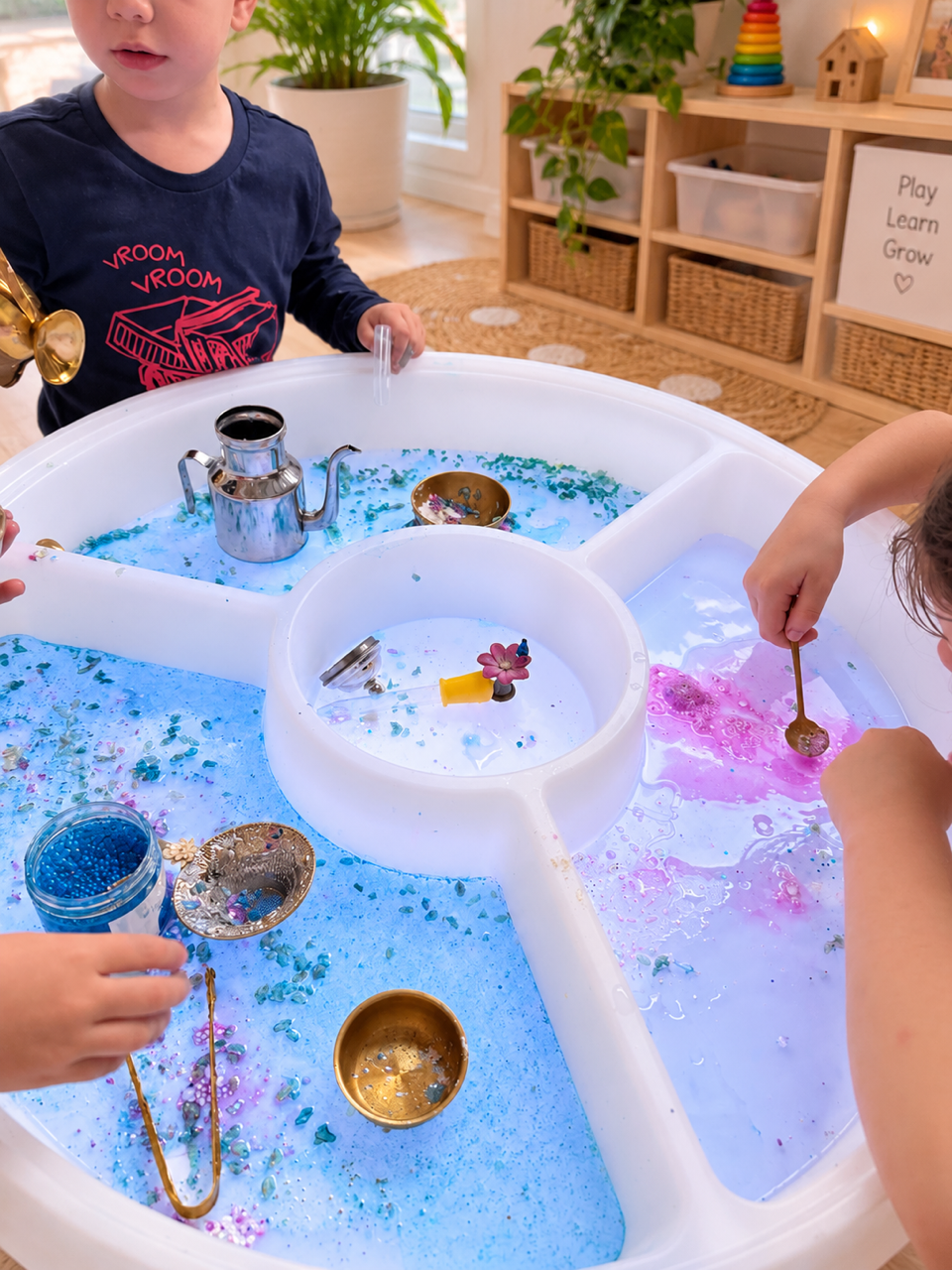
Turn off the big light, switch on the table, and watch what happens. A tub of jelly becomes a glowing gem mine. A jug of coloured water becomes a potion lab. Little hands that wouldn't sit still for five minutes suddenly have all the time in the world.
This week we're making rainbow glow jelly: a simple make-ahead sensory material that looks absolutely magical on a light table. It takes ten minutes to make the night before, costs a few dollars, and gives you a whole morning of play.
Why light play works so well
Light tables do something special to attention. The soft glow from underneath pulls children in, calms busy bodies and makes ordinary materials feel new. Translucent things suddenly show their colours, textures and tiny details in a way they never do on a kitchen table.
It's also wonderfully open-ended. There's no right way to play with glowing jelly. Some children will squish it for half an hour. Others will sort it, scoop it, hide treasures in it or turn it into a cake shop. All of it counts.
What you'll need
- 2 to 3 packets of jelly crystals in different colours (yellow, red and blue give you the brightest glow)
- Boiling and cold water, as per the packet
- Shallow containers or a lined baking tray to set each colour
- A blunt knife or cookie cutters
- Small loose parts: gems, acrylic shapes, buttons, plastic animals or bugs
- Scoops, spoons, tongs, cups and a few small bowls
- A light table, or any light source you can safely shine through a clear tub
How to make rainbow glow jelly
- Make each colour separately. Mix one packet of jelly with the boiling water as directed, then stir in slightly less cold water than the packet says. A firmer jelly holds its shape better for play.
- Add a little surprise. Before it sets, drop a few gems, acrylic shapes or plastic bugs into each tray. Kids love excavating them later.
- Set in shallow layers. Pour into shallow containers, about 2 to 3cm deep. Thin layers glow beautifully because the light shines straight through.
- Chill overnight. Pop it in the fridge until firm.
- Cut and tip out. In the morning, cut into cubes, stars or wobbly slabs and tip them out. Let the children help, they'll love the wobble.
Adults only for the boiling water step. For very little ones who still mouth everything, use taste-safe loose parts or skip them altogether.
Set up your invitation to play

Dim the room, switch on the light and choose a colour. Then:
- Put one colour in each zone. On the Large Sensory Light and Water Table, the four compartments make this easy: red jelly in one, blue in another, yellow in a third, and the centre well for treasures.
- Add tools, not instructions. Lay out scoops, tongs, cups and bowls around the edge and let the children decide what happens next.
- Change the light colour. Use the remote to switch the glow from white to blue to pink and watch the jelly change with it. Ask, "What happened to the red jelly when the light turned blue?"
Five ways to play
- Gem excavation. Dig, squish and scoop to rescue the treasures hidden inside. Count them as you find them.
- Colour mixing. Mash two colours together in a bowl. Does red and yellow really make orange? It does, and it glows.
- Jelly bakery. Cookie cutters, cupcake cases and a "shop" sign turn the table into a café. Great for role play and early maths.
- Bug rescue. Set plastic insects in the jelly and send in the rescue team with tongs and tweezers. Brilliant for fine motor skills.
- Light and shadow. Lay thin slices flat on the surface and add acrylic shapes on top. Talk about which things let light through and which block it.
What they're learning
It might look like squishing jelly, but there's a lot going on:
- Science: colour mixing, light and transparency, and how things change when they're cold, warm or squashed
- Fine motor: scooping, pinching, pouring and using tongs build the hand strength needed for writing
- Language: wobbly, squishy, glowing, slippery. Sensory play is full of new words
- Maths: counting treasures, sorting by colour and comparing "more" and "less"
- Regulation: the calm glow and repetitive squishing help children slow down and focus
For educators, this links beautifully to EYLF Outcome 4 (children are confident and involved learners) and Outcome 5 (children are effective communicators).
Clean-up tips
- Lay a towel around the base before you start. Jelly travels.
- When play is done, scoop the jelly into the bin, not the sink, so it doesn't block your drains.
- Wipe the play surface with warm soapy water and a soft cloth.
- Keep the underside, charging port and battery dry. The top surface is designed for water and sensory play, but the table shouldn't be submerged or hosed down.
Which light table is right for you?

- Large Sensory Light and Water Table with Compartments ($550). 81cm across with four separate play zones. Our pick for group play, early learning rooms and anyone who wants to offer different materials side by side.
- Sensory Light and Water Table ($400). A generous round bowl that's perfect for jelly, water, sand and foam at home.
- Sensory Mood Play Cube ($305). A glowing cube with a flat lit well that works as a light table, a play tray and a seat.
- Tabletop Sensory Light Play ($200). A compact touch-activated tray with eight glowing domes. A lovely first step into light play for smaller spaces.
All four are rechargeable and cord free, with up to 8 hours of play from a 2 hour charge, so you can set up anywhere without a power point.
Make it tonight. Play tomorrow. Watch them glow.