Does your toddler drop everything off the highchair, then watch it land? Does your four-year-old fill a bag with "treasures" and carry it from room to room, or line every car up in a perfect row? It can feel like a phase designed to test your patience, but there's usually a pattern behind it. Early childhood educators call these repeated urges play schemas, and once you can spot them, you can set up a tuff tray that gives those busy hands exactly what they're looking for.
This guide is for parents and educators alike: what schemas are, how to spot the common ones, and a simple "schema station" tray you can set up this week, plus quick swaps for each schema.
What are play schemas?
A schema is a repeated pattern of behaviour that children use to explore an idea, like how things move, fit, join or change. The idea was popularised by British early years researcher Chris Athey in her book Extending Thought in Young Children (1990), and it's now widely used in Australian early learning settings. Aussie Childcare Network lists nine common schemas, including:
- Trajectory: throwing, dropping, rolling and pouring, exploring how things move through space.
- Transporting: moving objects (or themselves) from one place to another in hands, bags, buckets and trucks.
- Enclosing and enveloping: building fences, filling containers, wrapping and hiding things.
- Positioning: lining things up, sorting and arranging items in rows or patterns.
- Connecting: joining and separating, like linking blocks or building and knocking down.
- Rotation: a fascination with spinning, wheels and things that go round.
- Transforming: mixing, squishing and watching materials change.
Most children move between several schemas, and some show a strong favourite for a while. The good news is that a tuff tray is the perfect place to say "yes" to them, because the mess has somewhere to go.
What you'll need for a schema station
- A tuff tray, ideally on a stand so two or three children can work around it at once
- A simple base: dry rice, oats, sand or water (or a taste-safe base for little ones who still mouth)
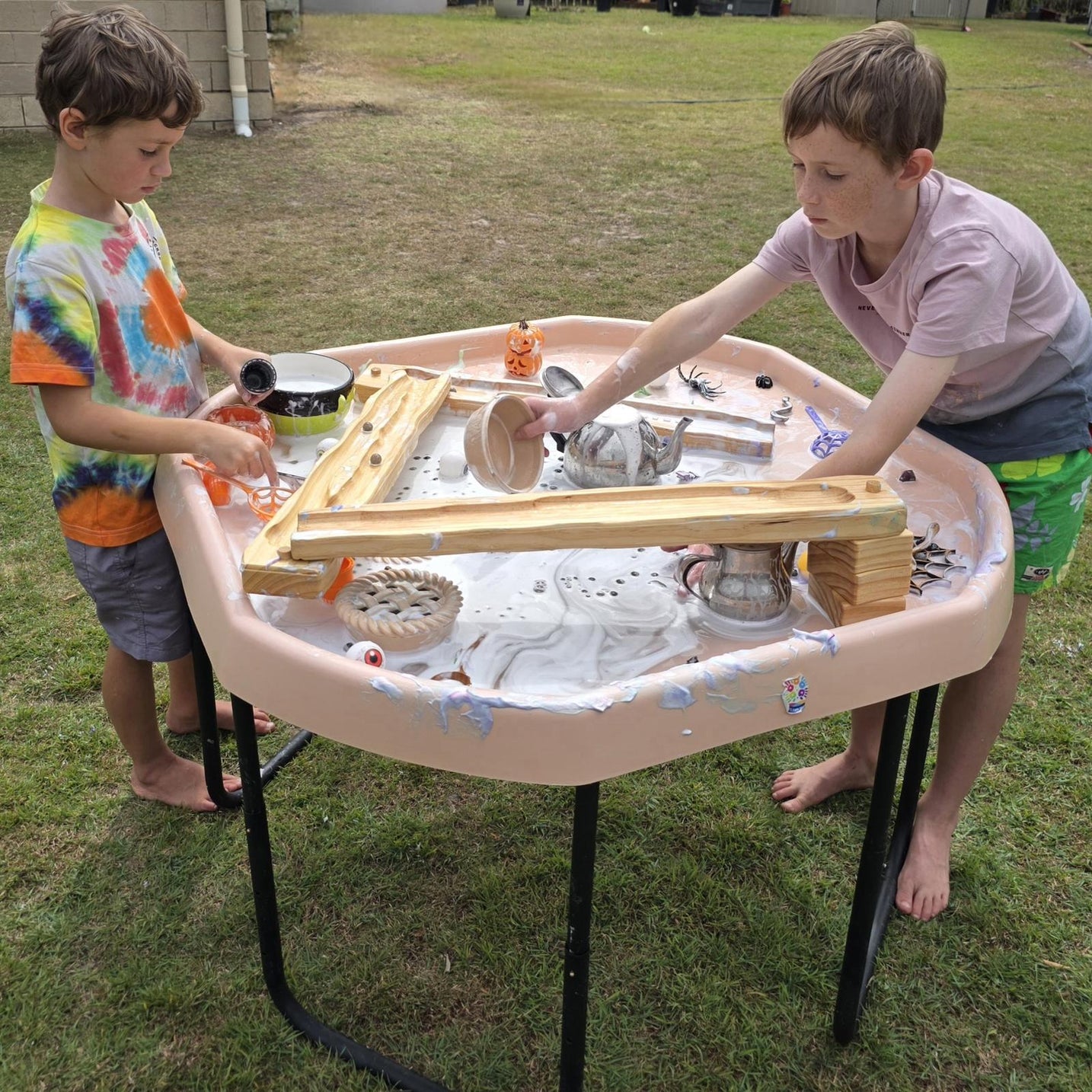
- Two or three ramps: offcuts of timber, guttering, cardboard tubes cut in half, or a chopping board propped on blocks
- Things to roll and drop: wooden balls, pinecones, large lids, cups and bowls
- Pouring tools: jugs, teapots, scoops, ladles and a funnel
- Things to carry: small baskets, buckets, egg cartons and toy trucks
- Things to arrange or enclose: wooden blocks, craft sticks, stones, gumnuts or garden clippings
- A towel and a dustpan and brush nearby

How to set it up
- Watch first. Spend a few days noticing what your child or group keeps doing. Are they throwing, carrying, lining up or wrapping? Jot it down; educators can add it to their observations.
- Add your base. Spread a thin layer across the tray. Dry bases are easiest to start with; save water for warm days outdoors.
- Build the ramps. Prop one end of each ramp on the tray rim or a stack of blocks so things run down into the base. Try different heights.
- Make zones. Put pouring tools at one end, baskets and trucks at another, and a pile of blocks and sticks in the middle. Leave plenty of empty space for children to fill.
- Offer, don't direct. Invite children over and let them find the part that suits them. Try comments like "I wonder where that will land?" rather than instructions.
- Follow their lead. If someone spends twenty minutes rolling pinecones, add more ramps tomorrow. If they're carrying, add a second tray or basket across the yard as a "delivery spot".
Quick swaps for each schema
Trajectory (the throwers, droppers and pourers)
Ramps of different lengths, balls and lids to race, jugs and watering cans for pouring, and a target bowl to aim at. A firm rule helps: "In the tray, we can throw. Out of the tray, we roll."
Transporting (the carriers)
Toy diggers and trucks with piles of "gravel" to move, buckets with handles, egg cartons and a second container to deliver to. A Busy City insert ($59.95) gives the trucks real roads to drive along.

Enclosing and enveloping (the fence builders and hiders)
Blocks and sticks to build fences and pens, a Grass insert ($32.95) as a paddock for farm animals, small boxes with lids, fabric scraps for wrapping, and animals to hide in the base and find again.
Positioning (the line-it-up crew)
Give them lots of the same thing: stones, gumnuts, spoons, leaves or garden clippings, plus an egg carton or muffin tin to sort into. Children in this schema often arrange things around the edge of the tray or in long rows. Resist the urge to tidy it up.

Connecting, rotation and transforming
For connectors, add blocks to build and knock down and ramps that join together. For spinners, offer toy cars, a salad spinner or a whisk. For transformers, a mixing bowl, water and a dry base to stir into goop will keep them busy. The White Board insert ($94.95) also works well for mark-makers who love drawing circles, lines and borders.
What they're learning
Schema play looks repetitive, but that repetition is how children test ideas. A child rolling a ball down a ramp over and over is exploring speed, height and cause and effect. A child carrying blocks across the yard is planning, counting and building strength. In the Early Years Learning Framework, this is Outcome 4, children are confident and involved learners, who develop skills "such as problem solving, inquiry, experimentation, hypothesising, researching and investigating."
Educator tip: schemas are a great lens for planning. If you notice a cluster of transporters in your room, set up two trays at opposite ends of the yard with baskets and trucks in between, and record what you see for your documentation.
Safety notes
- Small parts: under-3s are especially at risk of choking. Australia's product safety regulator uses a small parts cylinder 31mm wide and 57mm long to test toys for this age group (ACCC Product Safety). Keep balls, stones and loose parts larger than that for little ones, and supervise closely.
- Throwing rules: keep throwing inside the tray and use soft or light items.
- Natural materials: check that any plants, flowers or seed pods you add aren't toxic, and keep in mind children with hay fever or plant allergies.
- Food bases: check your group's allergy list before using rice, oats, flour or cereal, and heat-treat any raw flour before play.
- Water: always stay within arm's reach when water is in the tray.
Clean-up tip
Make "transporting" part of pack-up: hand your carriers a bucket and let them deliver the dry base back into its tub. Sweep the rest into the middle of the tray, tip it into a container, and wipe the tray down. If the set-up is working, pop a Tuff Tray Cover ($34.95) over it and pick up where they left off tomorrow, because schema play loves repetition.
Bring it home (or into your room)
A tray on a stand makes schema play so much easier: children can stand, move around and work side by side without everything ending up on the floor. Our Tuff Tray & Stand Package ($245) is the easiest place to start, or you can grab the Tuff Tray ($80) and Stand ($175) separately. For smaller spaces or one or two toddlers, the Small Tuff Tray & Stand Package ($190) is a lovely fit.
Setting up a room with a few schema stations? The Education Bundle ($1,047.50) includes three tray and stand packages, all seven full-size inserts and three covers. We ship Australia-wide, and if you'd like a quote for your school or centre, email me at emilie@busylittlefingers.com.au.
Watch what they keep doing, give it a tray, and let them repeat it as many times as they like.