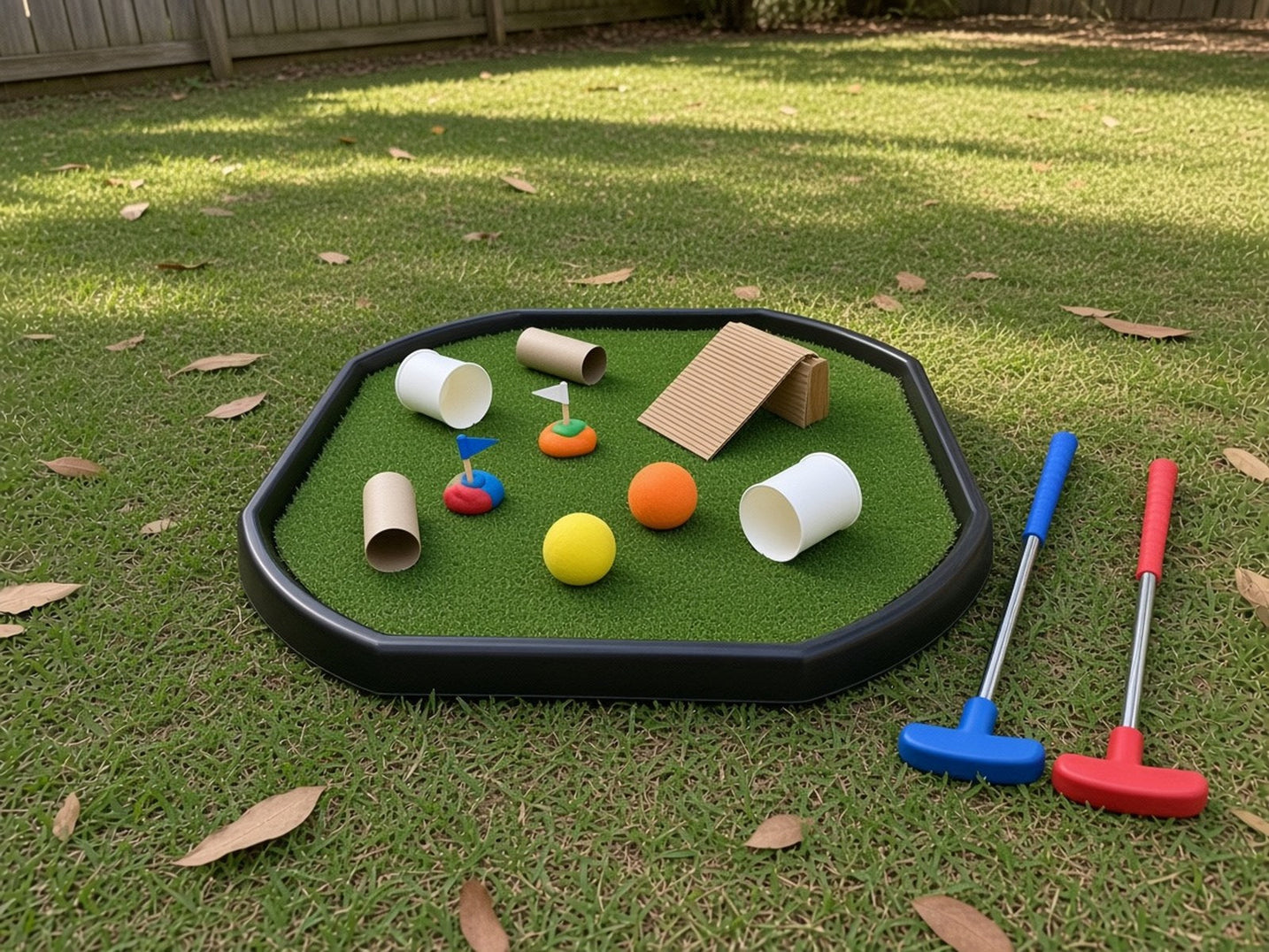
There's a moment every summer when the backyard gets too hot, the screens start calling, and someone says "I'm bored" for the fifth time before lunch. This is our go-to for that moment: a tiny mini golf course built right inside your tuff tray. It takes about ten minutes to set up, uses things you already have in the recycling bin, and the tray's raised rim does a brilliant job of keeping the ball (mostly) where it belongs.
It's a lovely one for the long afternoons between now and the end of the school year, and it moves happily from the backyard to the verandah to the lounge room floor when the heat kicks in. Educators, there's a note for you near the end too.
What you'll need
- A tuff tray, on the ground or on a stand. A Grass Tuff Tray Insert ($32.95) makes it look and feel like a real green, but a bare tray, a towel or an old placemat works too.
- A ball: a ping pong ball, a tennis ball or a small soft ball. For children under 3, choose a ball too big to fit in the ACCC's choke-check cylinder (more on that below).
- A "putter": a wooden spoon, a spatula, a short cardboard tube, or a toy golf club if you have one.
- Holes: paper or plastic cups laid on their sides, small bowls, or an egg carton with the lid cut off.
- Obstacles from the recycling: cardboard tubes (tunnels), bottle lids, small boxes, blocks, a strip of cardboard bent into a ramp, and a few smooth stones or pinecones.
- Optional extras: paper flags on pop sticks, a shallow dish of water as a "water hazard" (supervised, see the safety notes), a clipboard and pencil for scores.
How to set it up
- Lay your green. Pop the grass insert into the tray (or leave the tray bare for a faster, smoother course). If you're using a stand, set it at a height where your child can comfortably stand and swing without reaching up.
- Place one hole first. Lay a cup on its side near the far rim with the opening facing your child. Starting with one easy hole helps little ones get the idea before the course gets fancy.
- Add a tunnel. Tape a cardboard tube flat to the tray or insert so the ball can roll through it on the way to the hole. Little ones love watching it disappear and pop out the other side.
- Build a ramp. Fold a strip of cardboard into a gentle slope, or prop it on a block. Steeper ramps make the ball go faster, which is a great conversation starter.
- Use the rim. Show how the ball can bounce off the side of the tray, just like the edges on a real mini golf course. Bank shots are surprisingly addictive.
- Let them redesign. Once they've played a round, hand over the materials and let them move the holes and obstacles. This is where the real thinking happens.
- Keep score, or don't. Older kids might like tallying strokes on a clipboard. For toddlers, "Did it go in? Hooray!" is plenty.
Easy ways to change it up
- Numbered holes: write 1 to 5 on the cups and play them in order. Great for number recognition.
- Colour match: stick a coloured dot inside each cup and call out which colour to aim for.
- Blow golf: swap the putter for a straw and blow a ping pong ball around the course (best for preschoolers and up, and lovely for breath control).
- Small world golf: add a few toy animals as "spectators", or build a little clubhouse from a box.
- Two-player course: one child builds a hole, the other has to get the ball in. Then swap.
What they're learning
It looks like a simple game, but there's a lot going on:
- Hand-eye coordination and control. Lining up a gentle tap, judging how hard to hit and watching where the ball goes are all big skills for little bodies.
- Movement skills. Striking a ball is one of the "manipulative" fundamental movement skills the Early Years Learning Framework (EYLF V2.0) lists alongside catching, rolling, kicking and throwing. The EYLF also describes children who "manipulate equipment and manage tools with increasing competence and skill" as part of Outcome 3 (wellbeing).
- Early science and maths. Ramps, angles, speed, distance, more and fewer strokes: they're testing ideas every time they swing.
- Problem solving and resilience. When the ball keeps missing, they tweak the ramp, move the cup or try a softer tap. That's real persistence.
- Turn-taking. Mini golf is a natural way to practise waiting, cheering each other on and sharing one putter.
It's also a sneaky way to get them moving. The Australian Government's movement guidelines say preschoolers (3 to 5 years) should be active for at least 3 hours across the day, including 1 hour of energetic play, and that toddlers should get at least 3 hours of varied physical activity too (Department of Health, Disability and Ageing). A round of tray golf won't do all of that, but chasing the ball, crouching to line up shots and rebuilding the course all add up.
For educators
A mini golf tray works well as an outdoor station during the busy last weeks of Term 4, and it slots easily into a fundamental movement skills focus. A few ideas:
- Set up two or three trays as "holes" around the yard and let small groups move between them.
- Invite children to design and draw a course plan first, then build it. It's a lovely link between mark-making, planning and physical play.
- Ask families to send in clean cardboard tubes and lids, so the course becomes a shared project.
- Note the language you hear: "faster", "too hard", "next to", "through", "under". It's rich, natural maths talk.
If you're kitting out a room for 2027, our Education Bundle ($1,047.50) is built for group play. For quotes or multi-tray orders, email us at emilie@busylittlefingers.com.au.
Clean-up tip
This is one of the easiest clean-ups you'll ever have. Pull out the cups and cardboard (most of it can go straight back in the recycling), lift the grass insert out, give it a shake over the garden and wipe it down. If you want to leave the course set up for tomorrow, a Tuff Tray Cover ($34.95) keeps leaves, pets and curious fingers out overnight.
Safety notes
- Small balls and parts for under-3s. The ACCC says anything that fits completely inside its Choke Check cylinder could become lodged in a young child's throat. You can print and make your own from the ACCC Choke Check page. Check balls, bottle lids, stones and pinecones before toddlers play.
- Swinging space. Keep the putter short and set a "one golfer at a time" rule so no one gets a wooden spoon to the knee.
- Water hazards need eyes on them. If you add a dish of water, stay within arm's reach and tip it out straight after play. Royal Life Saving WA notes that toddlers can drown in as little as 3 cm of water (Keep Watch).
- Sun and heat. On hot days, set up in full shade or bring the tray inside. Cancer Council recommends sun protection whenever the UV Index is 3 or above (Generation SunSmart).
- Stands are for trays, not climbing. Our stand is made to hold your tray during supervised play, so remind little golfers not to lean or sit on it.
Make it your own
You don't need anything special to try tray golf, but a few pieces make it easier to set up again and again:
- Tuff Tray & Stand Package ($245): our most popular set-up, with the stand adjusting to 46, 56 or 66 cm. Our next shipment of full-size stands is due to land between 20 and 23 November, and stand orders ship as soon as they arrive.
- Tuff Tray ($80) on its own, if you're happy playing on the ground.
- Grass Tuff Tray Insert ($32.95), made to fit Busy Little Fingers Tuff Trays purchased from November 2025 onwards.
- Small Tuff Tray & Stand Package ($190) and Small Grass Insert ($24.95) for smaller spaces and little legs.
Our Black Friday sale runs from Monday 16 November to Tuesday 1 December with 15% off sitewide, so it's a good time to add a grass insert to your collection. We ship Australia-wide to families, schools, kindys and childcare centres.
If you build a course, we'd love to see it. Tag us on Instagram @busy_littlefingers or send a photo to emilie@busylittlefingers.com.au. Fore!
Emilie, the mum behind Busy Little Fingers