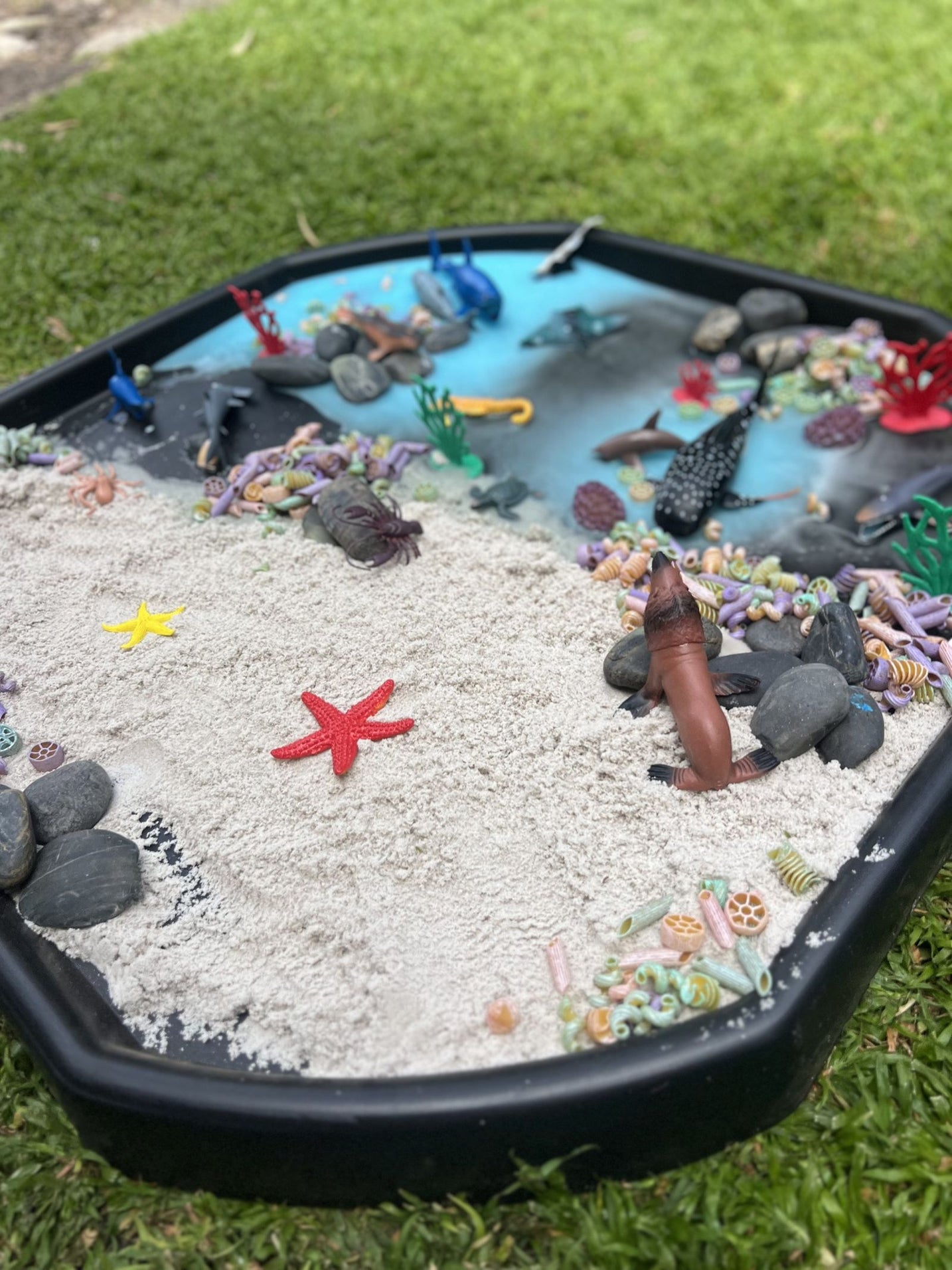
Some days it's simply too hot, too windy or too far to pack up the whole family (or the whole kindy room) for the beach. The good news? You can bring the beach to them. A tuff tray, a bag of sand, a few shells and a handful of sea creatures is all it takes to turn a shady corner of the backyard, verandah or classroom into a rock pool that little hands can explore for ages.
This beach-and-rock-pool set-up is designed for hot early-summer days: it's mostly dry, easy to keep in the shade, and you can add a splash of water when everyone needs cooling down. It works for one toddler at home or a small group at kindy, with a few tips for educators along the way.
What you'll need
- A tuff tray (a full-size tray gives you room for "beach" and "sea" side by side; a 70cm small tray suits one or two toddlers)
- A tray stand, if you'd like children standing and moving around the tray rather than kneeling on hot ground
- Washed play sand (the bagged kind sold for sandpits), or a taste-safe "sand" for babies and toddlers who still mouth (see the recipe below)
- Something blue for the sea: a blue insert or mat, a shallow tub of water, or blue-dyed sand or rice
- Shells, smooth stones, driftwood and pieces of coral-look loose parts
- Toy sea animals: turtles, crabs, fish, octopus, dolphins, a whale shark if you have one
- Dyed pasta shells for "sea treasure" (optional, recipe below)
- Small buckets, scoops, spades, a sieve, a magnifying glass and a couple of paintbrushes
- A towel and a dustpan and brush for clean-up

Two quick bases
Taste-safe "sand" for little mouthers
Real sand isn't food, so for babies and young toddlers who still put everything in their mouths, a heat-treated cloud dough makes a soft, mouldable "sand" instead.
- Heat-treat the flour first. Raw flour can carry bacteria such as E. coli, so spread 4 cups of plain flour on a lined baking tray and bake at about 180°C for 5 to 7 minutes, stirring halfway, until it reaches 74°C on a food thermometer. Let it cool completely and sift out any lumps.
- Rub in ½ cup of vegetable oil with your fingertips until it feels like damp sand and holds its shape when squeezed.
- For a golden beach colour, add a spoonful of cocoa or a few drops of yellow food colouring while you mix.
Allergy note: this base contains wheat (gluten). For a gluten-free option, use cornflour or crushed rice cereal instead, and always check the allergy list for your group.
Dyed pasta "sea treasure"
- Put 2 cups of dry pasta shells into a zip-lock bag or jar with 1 teaspoon of white vinegar and a few drops of food colouring.
- Seal and shake until evenly coated.
- Spread on baking paper and leave to dry for a few hours (or overnight) before playing.
Make a few colours (purple, pink, green and yellow look lovely against the sand) and scatter them through the rock pool as treasure to find and sort.
How to set up your beach in a tray
- Pick your shady spot. Set up under a tree, shade sail or verandah, ideally in the morning or late afternoon. Sand reflects UV, so keep hats on even in the shade.
- Make the beach. Pour sand into one half of the tray and push it up into a gentle slope, like a beach running down to the water.
- Add the sea. Fill the other half with your blue: an insert, blue rice or sand, or a shallow tub of water tucked into the sand.
- Build a rock pool. Ring smooth stones along the water's edge and tuck a few sea creatures into the gaps, so children have to peek, lift and discover.
- Hide the treasure. Bury shells, pasta shells and a few small animals in the sand for digging, sieving and brushing off like a little archaeologist.
- Invite, then step back. A simple prompt like "Who lives in the rock pool?" or "Can you find five shells?" is plenty. Let children lead the play from there.

Ways to extend the play
- Sort and count: group shells by size, colour or shape, then count them into buckets.
- Mark-making: draw letters, names and wiggly waves in smooth sand with a finger or a stick.
- Sea creature homes: talk about who lives in the rock pool, who lives in the deep sea, and who comes up on the sand. Turtles are a great one for this!
- Land, sea and shore: older children can build a whole small world with land, beach and ocean sections, then decide where each animal belongs.
- A cooling splash: on a really hot afternoon, add a tub of water so children can wash shells and "rescue" animals from the waves.

What they're learning
- Sensory exploration: dry sand, damp sand, smooth stones and bumpy shells give children loads of contrasting textures to describe.
- Science and the natural world: talking about where animals live, what tides do and how shells protect sea creatures builds early knowledge of living things and habitats.
- Maths: sorting, counting, comparing big and small, and filling and emptying buckets.
- Language: new words like rock pool, tide, shore, octopus and camouflage come up naturally during play.
- Fine motor skills: pinching shells, brushing sand and scooping strengthen the small hand muscles children need for drawing and writing later on.
For educators, this links neatly to the Early Years Learning Framework outcome that children are connected with and contribute to their world, and it's an easy way to bring beach-safety conversations into the room before the summer holidays.
Educator tips
- Set it up in a shaded part of the yard and plan sand play for the cooler parts of the day.
- Keep a dustpan and brush, a small bin and a "sand stays in the tray" reminder close by, so children can help with clean-up.
- Rotate the loose parts (shells one week, stones and driftwood the next) to keep interest high through Term 4.
- Use the tray to start conversations about sun and water safety: hats, shade, swimming between the flags and always having a grown-up watching.
Safety notes
- Sun protection: Cancer Council recommends sun protection whenever the UV Index is 3 or above, using clothing, a broad-brimmed hat, shade, sunglasses and SPF50+ sunscreen together. Shade alone isn't enough, because sand reflects UV. Babies under 12 months should be kept out of direct sun when UV is 3 or above. Check your local sun protection times on the free SunSmart app.
- Any water, any depth: if you add water, Royal Life Saving's Keep Watch advice is to actively supervise children aged 0 to 4 and stay within arm's reach. Tip the water out as soon as play is over.
- Small parts: shells, pebbles and pasta can be choking hazards for under-threes. Choose larger pieces and supervise closely.
- Sand hygiene: use washed play sand rather than builder's sand, keep it covered between sessions so pets and wildlife stay out, and wash hands after play.
- Allergies: the cloud dough contains wheat and the pasta usually contains wheat and sometimes egg. Check labels against your group's allergy list.
Clean-up tip
Let damp sand dry in the sun, then brush it into one corner of the tray and tip it back into a lidded tub for next time. Rinse shells and animals in a bucket of warm, soapy water and leave them to dry on a towel. A tray cover keeps everything clean between sessions, so your beach is ready to go the next hot day.
Make it your own
Our Tuff Tray & Stand Package ($245) gives you a full-size tray at a comfortable standing height, so a small group can gather around the beach together. Already have a stand? The Tuff Tray on its own is $80 in black, white or beige, and the Tuff Tray Stand is $175. For toddlers, the Small Tuff Tray & Stand Package ($190) is just the right size.
Want a sea without the splashes? The Water World Tuff Tray Insert ($59.95) drops into your tray as an instant ocean, and the Tuff Tray Cover ($34.95) keeps your sand clean and dry between sessions. You might also like our homemade kinetic sand guide for another sandy base to try.
We ship Australia-wide, and educators can ask us about classroom quotes. Questions about which tray suits your space? Email me at emilie@busylittlefingers.com.au. I'd love to see your beach trays too!